
SEND Support Hub

.jpg?v=1792208291)

Welcome to our SEND Support Hub for parents and carers
We understand that every child is unique, and for some, that journey includes navigating special educational needs and disabilities (SEND). Whether your child has a diagnosis or you believe they may have additional needs, this area of our website is dedicated to you.
Here, you’ll find clear, compassionate information and practical guidance to help you support your child both in education and beyond. From understanding the SEND process to accessing resources and connecting with support networks, we’re here to support you and help your child thrive.
All policy and practice at Holy Cross and All Saints is in line with current Government Guidance, including the SEND Code of Conduct and the Children and Families Act (2014) and the Education Endowment Foundation (EEF) Guidance report on Special Educational Needs in Mainstream Schools.
Our coordinator in school for pupils with Special Educational Needs and Disabilities (SENDCo) is Ms Richardson
If you would like to contact Ms Richardson, please telephone the school office on 0161 789 4386 or email sendco@holycrossallsaints.salford.sch.uk.
Our nominated Governor for SEN pupils is Mrs J Arslan.
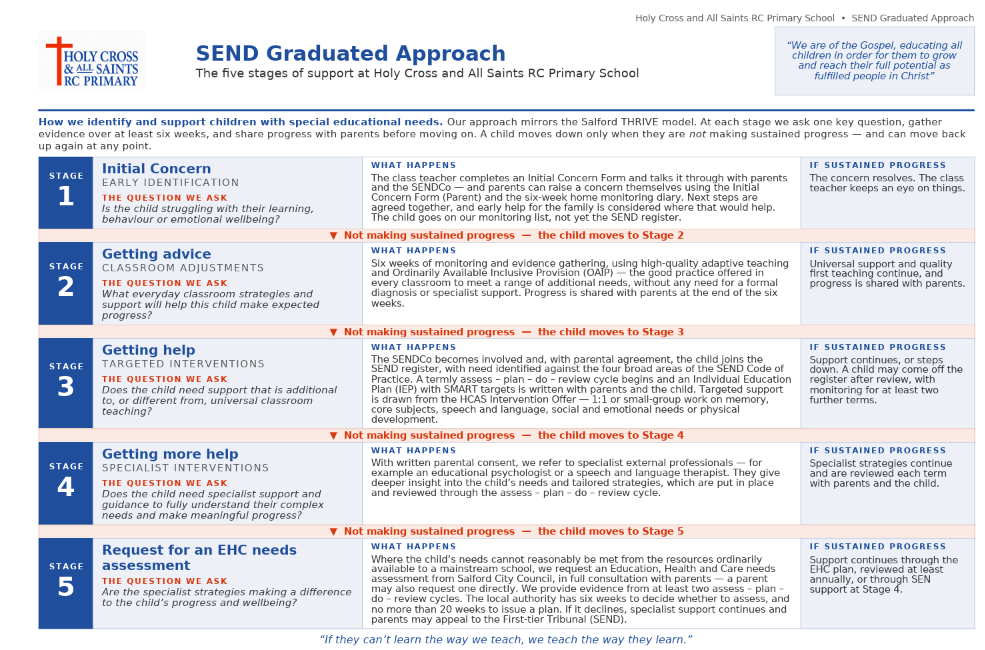
SEND Graduated Approach at Holy Cross and All Saints RC Primary School
Whole School Inclusion Statement
At Holy Cross and All Saints our mission statement states,
‘We are of the Gospel, educating all children in order for them to grow and reach their full potential as fulfilled people in Christ.’
Our school family nurtures a culture of Christian love and respect for each other and the world around us. Togetherness, patience and compassion are encouraged. By providing creative experiences and challenges for all learners, children grow in resilience, learn to persevere and develop belief in themselves and build hopes and dreams for their future.
We provide an inclusive learning environment in which every child can achieve and reach their full potential and this is at the heart of everything we do. We ensure that all pupils have equal access to a broad, balanced curriculum, delivered through quality first teaching, which is adapted to meet individual needs and learning styles.
We aim to identify barriers to learning as early as possible so that we can provide evidence-based interventions to support and overcome additional needs. Where necessary, external agencies provide us with further strategies to allow our children to make progress towards their desired learning and developmental outcomes. Together, we are passionate that our children reach their full potential at every step of their learning journey at Holy Cross and All Saints School.
Successful inclusion should:
- This results in every pupil feeling safe, confident and happy at school.
- See every pupil making the best progress in which they are able to enjoy their time at school: in lessons, during their playtime or at lunchtime or when involved in any of our extended school activities.
- Promote every child's belief in themselves as a learner and valued member of our school community.
Successful inclusive provision at Holy Cross and All Saints School is seen as the responsibility of the whole school community, permeating all aspects of school life and applicable to all our children.
SEND Children THRIVE Graduated Approach
The Thrive model is an effective approach to supporting children and families with Special Educational Needs and Disabilities. It supports mainstream and specialist schools with SEND processes; from early identification of need, making adjustments, removing barriers to learning and seeking effective SEND Support interventions and specialist support as needed.
This is what we call a Graduated Approach.
The THRIVE conceptual framework was developed by a collaboration of authors from the Anna Freud National Centre for Children and Families and the Tavistock and Portman NHS Foundation Trust.
The main THRIVE tool is organised by type of need and key stage. The sections cover:
The resource is separated into three parts:
- Best practice walkthrough (Ordinarily Available Inclusive Provision)
- Main THRIVE tool
- Getting risk support
What is Ordinarily Available Inclusive Provision’?
Ordinarily Available Inclusive Provision describes the range of support, strategies and activities, that is available in early years settings and to young children with additional needs without the need for a formal diagnosis or specialist support: what is available as part of the basic good practice in the setting. The overarching approach is one of inclusion: a good practitioner teaches a child / young person from wherever they are on their developmental journey, and this includes those who may have additional needs.
It is expected that the vast majority of children will have their needs met by universal and mainstream services through an ethos of best practice and reasonable adjustments in line with the SEND Code of Practice (DfE Jan 2015) which states, para 6:15, that
"A pupil has SEN where their learning difficulty calls for special educational provision, namely provision different from or additional to that ordinarily available to pupils of the same age"
Best practice walkthrough gives an overview of Special Educational Needs (SEN) and the graduated approach. It also provides guidance documents for parents.
The main THRIVE tool is organised by type of need and key stage. The sections cover:
- Getting advice (adjustments in the classroom)
- Getting help (targeted interventions)
- Getting more help (specialist interventions)
To learn more about how the Thrive tool is used in Salford early years settings and schools;
Salford Local Offer for Children with Special Educational Needs and Disabilities
Emotional Based School Avoidance EBSANot Fine in School - School Refusal, School Attenan
Emotionally Based School Avoidance happens when a child feels unable to attend school due to emotional distress. It’s more common than many people realise, and with the right support, children can rebuild confidence and re-engage with learning.
What EBSA Can Look Like
-
Worry, panic, or physical symptoms before school (tummy aches, headaches, nausea)
-
Difficulty separating from home or caregivers
-
Refusal to leave the house or get ready
-
Tearfulness, anger, or shutdowns linked to school
-
Avoiding certain lessons, peers, or times of day
These behaviours are signals of distress, not defiance.
Key Principles for Supporting Your Child
-
Stay calm, curious, and connected
-
Focus on understanding the why behind the avoidance
-
Work in partnership with school as early as possible
-
Aim for small, achievable steps rather than a solution
-
Celebrate progress, however small it may seem
Practical Strategies That Can Help
1. Strengthen Emotional Safety
-
Create predictable morning routines
-
Use visual timetables or checklists
-
Offer choices to increase your child’s sense of control e.g “Shall we leave the house at 8:20 or 8:30?” “Do you want to pack your bag yourself or do it together?” “Do you want to start the day in the classroom or the quiet space?”
-
Practise calming techniques together (deep breathing, sensory toys, affirmations)
2. Reduce Anxiety Triggers
-
Identify patterns: certain lessons, social situations, transitions
-
Ask school for adjustments such as:
-
A quiet space on arrival
-
A named trusted adult to meet at the gate
-
Reduced timetable for a short period
-
Early or later entry to avoid busy corridors
-
3. Build School Connection
-
Meet key staff in a calm environment
-
Start with partial attendance if needed
-
Use interests to motivate engagement (clubs, favourite subjects)
4. Support Emotional Expression
-
Encourage your child to talk, draw, or write about their feelings
-
Validate their emotions (“I can see this feels really hard”)
-
Focus on coping skills that :
-
Let’s plan how you can get through the first ten minutes?
-
Would you like to use your breathing exercise or your fidget toy?
-
Do you want to talk about what’s worrying you or draw it instead?
-
5. Look After Yourself
Supporting a child with EBSA is emotionally demanding.
-
Reach out for support
-
Share the load with school
-
Take breaks when you can
Local Support in Salford
Salford Educational Psychology Service:
Supports schools and families with EBSA planning and assessment. School referral.
Salford Early Help Team: Offers family support, parenting guidance, and practical help. Contact via Salford City Council website or school referral.
Salford CAMHS (Child & Adolescent Mental Health Service): For children experiencing significant anxiety or emotional distress. Referral by GP or school.
Salford Thrive Network: Local mental health support for children and young people.
National Helplines & Online Support
YoungMinds Parent Helpline: Support for parents worried about a child’s mental health.
Helpline: 0808 802 5544
NSPCC Helpline: Advice for any concerns about a child’s wellbeing.
Helpline: 0808 800 5000
Samaritans: Emotional support for adults who are struggling.
Helpline: 116 123
Anna Freud Centre
Guides for parents and schools on supporting emotionally based school avoidance.
Not Fine in School
Parent-led organisation offering guidance and advocacy.
Useful Online Guides & Tools
-
Working together to improve school attendance - GOV.UK – understanding your rights and responsibilities
-
Anxiety and Anxiety Disorders | Signs and symptoms | YoungMinds – practical strategies for families
-
MindEd For Families– free online learning about children’s mental health
-
Health and wellbeing - BBC Bitesize – child-friendly videos and coping tools
When to Seek Additional Help
Reach out for professional support if:
-
Your child’s anxiety is worsening
-
School refusal has lasted more than two weeks
-
Your child is showing signs of depression, panic, or withdrawal
-
You feel overwhelmed or unsure how to help
You’re not alone — EBSA is a shared challenge, and early support makes a real difference.
Useful Links for Parents and Carers
Salford Information Advice and Support Services (SIASS) offer support for families with children with SEND. They can be particularly helpful for families with a child undergoing formal assessment or in receipt of a Statement of SEN /EHCP. The parent partnership service is available to all parents/carers of pupils with special educational needs (SEN) who live in Salford.
Call 0161 778 0343/0349 or email siass@salford.gov.uk
Salford Family Forum
The Salford Parent Carer Forum supports parents and carers of children and young people with Special Educational Needs and/or Disabilities. They can listen to your concerns, ensure you know what services are available to your family, and offer peer support as and when you need it.
(IPSEA) Independent Provider of Special Education Advice
The leading charity in the field of SEND law in England, providing free and independent legal advice and support to families of children and young people with SEND.
Other useful websites and links:
https://www.adhdfoundation.org.uk/
Salford CAMHS - Royal Manchester Children's Hospital
http://www.dyspraxiafoundation.org.uk/